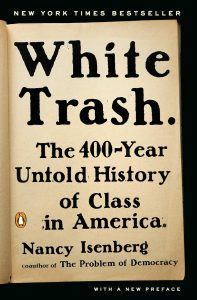
 Takeaway: Class matters. The idealism of a classless society and the myth that everyone can move up the social ladder with a little hard work has never been true for the majority in the United States.
Class matters. That shouldn’t be a controversial idea, but it is. It is controversial because it flies in the face of the American myth. It is possible to point to many that have risen up from their poor roots to achieve more than those that grew up around them. But the very pointing out that you know someone that grew up poor and is now rich only serves as a reminder that it is not the story of the majority.
White Trash is a provocative book. I do not think it is a particularly untold story as the subtitle suggests, but I think it is an under-represented story. Early US immigration was primarily fueled by lower classes. Early history of government is a master class in how the powerful can manipulate government to remain in power and use that power to enrich themselves at the expense of the poor.
From the early days of America, there was an understanding of poverty as something that was “˜congenital’. Prior to Darwin, Isenberg widely quotes founding fathers and essayists using language of animal husbandry. Whether the image was of dog breeding or horse breeding, the point was that if you have a cur, it is probably because the animal was of bad stock.





 Takeaway: The downfall of greatness seems to be written in advance by the weaknesses that are inverse to the greatness.