 Summary: “…the truth that God is love lies at the heart of all divine revelation.”
I am often reluctant to write about books where I know the authors. It is not because the books are not good, they often are very good. But sometimes it hard to separate the book from the larger lifework of the person that you know outside of just the book.
I didn’t meet John Armstrong until about 15 years ago. We had lots of mutual friends because we were both in the Chicago area and were connected to Wheaton College. But it wasn’t until I moved to suburban Atlanta that we actually met during an ecumenical meeting here that John hosted and then another conference on friendship in Chicago. We have kept in connect and I try to participate as much as possible in The Initiative, an ecumenical group that grew out of John’s earlier work.
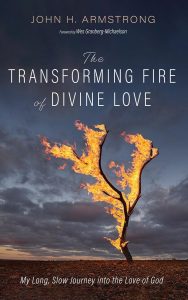
I think in many ways The Transforming Fire of Divine Love is a natural outgrowth of John Armstrong’s story and his focus on Missional-Ecumenism. Part of what John Armstrong is doing in the The Transforming Fire of Divine Love is narrating his story of how his interaction with both God and other christians moved him from a more closed faith to a more open faith that both recognizes the contributions of other streams of Christianity and recognizes the importance of cooperation and understanding between those steams to become the whole Church.
The Transforming Fire of Divine Love is not a memoir, but he does use his story to illustrate his point. I read Byron Borger‘s review in his column at Hearts and Minds books and I think that Borger gets it right that The Transforming Fire of Divine Love is interested in not just whether God is love is a true statement, but what we do with the reality of God’s love in understanding our theology and our view of the transformation of the Christian’s life. I also agree with Borger’s point that part of the value of Armstrong’s book is that it introduces the reader to the breadth of Christian theology. This is quite quote from Borger:
Love is the key, and he uses everyone from the most dense Orthodox thinkers to dear Max Lucado to sophisticated solid writers like Fleming Rutledge to flesh this out, to underscore its centrality to our faith. He draws on so many great writers that this book actually serves as an introduction to some of the finest thinkers in church history — from the ancient fathers to Kallistos Ware to Frederick Buechner to Karl Rahner to Brad Jersak.
(I have picked up three books that were mentioned or cited so far.)