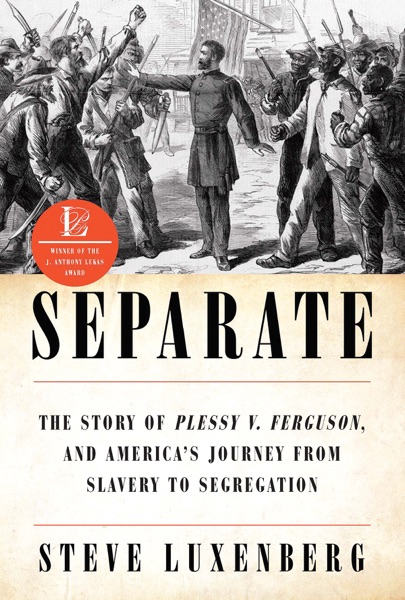
 Summary: A contextual and narrative history of the Plessey V Ferguson Supreme Court Ruling.
Part of what I appreciate about the framing of Separate is that Luxenberg takes great pains to point out segregation’s national history, not just its Southern history. It is undoubtedly true that Plessy was arrested in Louisiana, and the movement in the 1880s and 90s for southern segregation was a response to the political realities and white supremacy of the post-reconstruction era. But segregated rail cars were first established in the 1840s in Massachusetts. Frederick Douglas, Sojourner Truth, Harriet Tubman, Robert Small, and many other abolitions were removed (often forcefully and with significant harm) either from the train or to segregated cars. There is a good discussion of this history in the biographies linked above, but also a good part of Until Justice Be Done, about the movement for civil rights before the Civil War, is about the role of civil rights in transportation. Before the mid-20th century, virtually everyone that traveled used some paid transportation. Individual vehicles or even private horses or carriages were incapable of long-distance travel either because of cost or effort.
Like Heart of Atlanta: Five Black Pastors and the Supreme Court Victory for Integration by Ronnie Greene, also a book on a civil rights Supreme Court case written by a journalist, most of the book is about the context and facts of the case, not the legal decision. In fact, the discussion of the actual case and ruling doesn’t happen until the final section, about 90 percent of the way through the book. This feature is both the best and worst part of the book. The extensive context is framed primarily around the biographies of Justice John Harlan (who wrote the dissent), Albion Tourgee, lead counsel for Plessy, and Henry Billings Brown, the author of the majority opinion. There were also biographical portions for Louis Martinet (who conceived of the suit as a test case) and Homer Plessy (the man who was arrested as part of the test case). And, of course, the history of segregated transportation and the New Orleans Creole community, which drove the case.
At the end of the book, I appreciate why Steve Luxenberg gave us all of the context, but the moving back and forth between the three main characters was sometimes confusing. (This is probably because I mostly listened to this on audiobook). And I very much appreciate the reality that Luxenberg points out that what killed reconstruction, the Civil Rights Act of 1875, and caused the result of Plessy was the actions of moderate Republicans as much as pro-segregationist southern Democrats. John Marshall Harlan’s dissent in the Civil Rights Act of 1875 case was a preview of Plessy and is discussed in light of that. But in both cases, the only dissenter was Harlan, who was also the only Southerner on the court at the time.
Read more
 Summary: A long lecture or short book on ways to prevent tyranny based on 20th-century history.