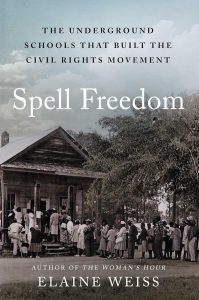
 Summary: Tracing the story of “Freedom School” as one of the backbones of the Civil Rights movement.
When I first heard about Spell Freedom, I thought it was a history of the Highlander Folk School. The Highlander Folk School played an important part in establishing the early freedom schools and eventually moved their teacher training program (and main Freedom school staff person, Septima Clark) to the SCLC. As is made clear in the book, the Highlander Folk School played an important behind the scenes role in the Civil Rights Movement. By the early 1950s, when Septima Clark attended her first training program, Highlander had been around for nearly 30 years. It was consciously integrated from early on, but its work shifted from labor organizing to civil rights organizing in the late 1940s. Clark quickly started leading training sessions and soon after, was forced out of her teaching job in Charleston SC because she was a member of the NAACP and in leadership of the local chapter.
The most likely reason that someone may know about Highlander Folk School is because Rosa Park attended one of Clark’s early training session in the summer of 1954, just before she prompted Montgomery Bus Boycott. Clark and Parks became life long friends. And it was not long after that Septima Clark first met Ella Baker. At the time Ella Baker was an organizer for the SCLC and their voting right program was floundering. The Nashville sit-in movement came to Highlander for training and Ella Baker used Highlander regularly as SNCC was developed. But about this time, the state of Tennessee was able to confiscate the property and shut down the Highlander Folk School, forcing it to move and reincorporate.
While Ella Baker had left the SCLC and become the primary advisor for the development of SNCC, the SCLC took over Highlander’s freedom school program and brought Septima Clark on staff and she became the first female board member. The sexism of the SCLC was frustrating to Clark, as it had been to Baker, but Clark continued to develop the freedom schools and work for voting rights, including playing a significant role in Selma. Hundreds of thousands of people were registered to vote as an indirect result of the freedom schools. Many of the major leaders of the Civil Rights era were either trained at Highlander, or in one of the freedom schools that were taught by volunteers that were trained by Clark or her staff at either Highlander or SCLC. (This includes John Lewis, Fannie Lou Hamer, Rosa Parks, Stokley Carmichael, and many more.)
As with many other histories of the Civil Rights era, there is a lot of overlap because different books are telling different facets of the same broad story. One of the facets here that is important is the role of radical white supporters of integration who helped to train Black civil rights leaders. Myles and Zilphia Mae Horton, as the founders of Highlander, and then later Guy Carawan and his wife Candy were strongly involved, but also seemed, at least in this telling, to understand their role to primarily be empowering Black leadership. Zilphia Mae understood the role of song as both ice breaker and encouragement and the civil rights movement and the Black church tradition also used music well. But again, even if helping, appropriation can be easy. Zilphia taught We Shall Overcome to participants at Highlander, but she didn’t write it, she learned it from Black women who sang a version of it during labor strikes. Zilphia did standardize some of the lyrics and then Guy Carawan, Pete Seager and Joan Baez recorded versions of it that became more widely known as a protest song. The arrangement was copyrighted by Zilphia Horton, Guy Carawan, Frank Hamilton, and Pete Seeger in 1960 and copyright lawsuits continue around the song until 2017 when a ruling finally placed it in the public domain.
Spell Freedom is a good narrative history of an aspect of the Civil Rights movement that is less known than the demonstrations and protests. But without training of the Highlander School and the grass roots work of local organizing with the freedom schools, much of the more public works would have been less effective.
Spell Freedom: The Underground Schools That Built the Civil Rights Movement by Elaine Weiss Purchase Links: Hardcover, Kindle Edition, Audible.com Audiobook