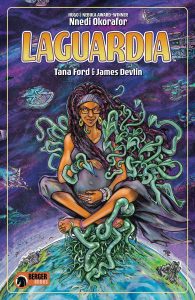
 Summary: A fictional story in response to the Muslim immigration/travel ban from the first Trump administration.
I picked this up on sale years ago, but like many books I pick up on sale, it can takes years get around to reading it. I read it today in part because I have been trying to decide whether to keep a Kindle Colorsoft that I purchased a few weeks ago.
I read it outside and that outside light offsets the fact that the Colorsoft is pretty dark generally. I won’t turn this into a review of the Colorsoft, but I do want to note that it was a digital ebook and it looked great in full color.
I am a fan of Nnedi Okorafor’s writing. LaGuardia is the 8th book/novella that I have read from her. She is writing scifi/fantasy from an African perspective. My favorite of her books is the Binti trilogy.
This is a near future story where Aliens (from space) were in both Nigeria and the United States. Contextually, it appears that the aliens came to Africa first. The main character, Future Nwafor Chukwuebuka, was born in the US to Nigerian parents who were doctors. Those doctors died in a terrorist bombing in the US that was protesting alien immigration to the US. After that bombing, Future, also a doctor, went back to Nigeria to start a medical clinic. As the story unfolds, the reader comes to figure out why the pregnant Future had returned to the US to have her baby.
Future’s grandmother, and only family, is an immigration lawyer. And much of the rest of the story is about immigration through LaGuardia with actual space aliens and humans from a different country that reframed the immigration debate of 2017-18 with specific country travels bans. Reading this in 2026 when the debate is no less xenophobic, but it still has shifted some of the area of discussion, Okorafor’s writing about “aliens” coming to the US and providing value, but being scapegoated for other problems, is still very relevant.
Any graphic novel is in part about the art. Many of the aliens in this book are plant based and part of the service that the give to humans is being able to graft their own plant parts onto humans to replace lost limbs. But that requires incorporating alien DNA into the humans who get help. That then impacts how others perceive them as human. If those who are human and alien because of the mixed DNA, then can people start calling for “human-only” institutions. This is very clearly a metaphor for various forms of segregation. And Okorafor isn’t only blaming the US here. Part of the reason that she has Future coming to the US, is that there was xenophobic movement in Nigeria. And the (space) aliens were themselves involve in a war across species that mirrored some of the ways that human racism or xenophobia occurs.
Novels and other fiction can reframe discussions. Graphic novels can be a way that draws people into texts for discussion who may not be willing to read a denser book. LaGuardia is worth reading, even if the story can be a bit heavy handed in its metaphors at times.
LaGuardia by Nnedi Okorafor Purchase Links: Hardcover, Kindle Edition