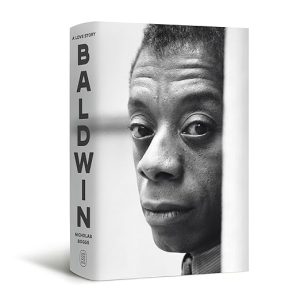
 Summary: A significant biography of James Baldwin.
There have been several biographies of James Baldwin. David Leemings’ biography is well worth reading, but Leeming was close to Baldwin, working at times as his secretary, travel companion and corespondent. That type of closeness has a benefit to a biographer, but it also has some weaknesses. I tend to think that we get a lot from biographies written by people close to the subject, but we also need a good biography from someone that isn’t personally close to the subject.
Nicholas Boggs is fulfilling that role for Baldwin. Leeming’s biography came out in 1995, but since that time there has not been a full biography of James Baldwin. Boggs main focus is connecting Baldwin’s writing to his life and his life to his writing. And at the same time showing how the fiction informed the non-fiction and how the non-fiction informed the fiction. Lemming discussed the writing as well, you can’t be a biographer of an author like Baldwin without discussing the writing, but I think Boggs made the writing a more central feature of the biography.
It is at the end of the book, one of the main contributions of this biography is a long exploration of Baldwin’s relationship with Yoran Cazac, a french painter that he originally met in Baldwin’s early days in Paris, but with whom they reconnected in the last 1960s. Baldwin had a “type”. He seemed to be attracted to men who were primarily attracted to women but still related well to him. There was a pattern with Lucien Happersberger, Engin Cezzar, David Leeming and Yoran Cazac and others. These men may not have had sexual relationships with Baldwin, but they were relationally intimate. Boggs suggests that Yoran Cazac was the last significant relationship that Baldwin had. Cazac was likely originally introduced to Baldwin through Baldwin’s mentor Beauford Delaney. And it is also likely that it was through Delaney that they became reacquainted.
Boggs found a copy of a out of print book that Baldwin wrote and Cazac illustrated, Little Man, Little Man: A Story of a Childhood. Boggs explored that little known book and found Cazac and befriended him and his family and worked to get Baldwin’s only children’s book republished. And in the mean time, interviewed Cazac and his ex-wife and children and those around him to get a view on a portion of Baldwin’s life that was almost barely mentioned in Leeming’s work. Part of what Boggs’ is illustrating in how he suggests that Baldwin’s writing was not just biographical or psychologically informative, but also descriptive of unrealized desires and realities. After Baldwin and Cazac reconnected, Cazac married Beatrice Mathews. When Beatrice was about six month pregnant with their first child (Cazac had another child from an earlier relationship), and her and Cazac were living in a rural Tuscan house without running water or electricity, Cazac and Baldwin spent about six weeks together at Balwin’s french home with Baldwin writing and Cazac painting and them spending time together. After the birth, Baldwin and his entourage went to Tuscany and Baldwin became the godparent of their son (just like Baldwin was the godparent of Lucian’s first son). And all of that was not unlike Giovanni’s Room where the one lover returns to his fiancé to get married and live out that domestic life. Baldwin wanted a domestic life and talked about marriage and children but never was able to achieve for long that domestic life that he kept trying to find.
At the end of the book in the author’s notes, Boggs talks about how Baldwin was an iconic figure for him as a gay man. Baldwin mostly did not talk about his relationships publicly. But he did write about relationships fictionally, and you can see the connections. Boggs explores Baldwin’s sexuality more than other biographers, but not focused on the details as much as the ways that Baldwin’s emotional life mattered to his writing live and vice versa. As Boggs notes several times, Baldwin often became physically sick after emotionally taxing relational difficulties. And many of his closest relationships where there was clear love, do not seem to have been sexually consummated (as with Delaney or Mary Painter and others). The point in the exploration is that this relational connection between people was important to who Baldwin was. Not just because being a gay black man was part of his identity, but because that identity influenced how he saw the world in ways that wasn’t true of everyone. Boggs asserts that while Baldwin did not always see the ways that oppression intersected across various identities, over time he came to see how sexism within the Black community or the racism within the gay community or the classism within the expatriate community intersected to mean that oppression does not simply run one way.
Greg Garret’s Gospel According to Baldwin makes a similar claim. I also think that Garret may have a better framing of how the homophobia of 1940-60s, when Baldwin is coming of age, prevented the deep connection that Baldwin seems to be forever searching for. The very nature of hiding your sexuality, even if Baldwin hid it less than many others did, makes it difficult to have an abiding public relationship. There is a reality to way that George Yancy’s framing of anti-sexist sexist works in Baldwin. Baldwin wanted a domestic household. But he also wanted someone to do the domestic work as he created. Beatrice Mathews says the same thing about Cazac to Boggs when he interviews her. She says that Cazac needed someone to care for everything around him so that he could paint. And that Baldwin and Cazac both wanted someone else to do that for them. There is a reality of sexism in that desire to have others care for you that seems common among many men that have imbibed a bit of narcissism in their approach to the domestic sphere. And it seems that Lucian and some of the others whom Baldwin loved, wanted to share the spotlight not just support his own spotlight. Baldwin often fell in love with artists or musicians or writers and tried to help them with their own creativity through funding or connections or lessons, but there seems to be a bit of jealousy, or at least control, that was part of the breakdown of many of those relationships.
Baldwin: A Love Story is a long biography. Many will not be interested in nearly 800 pages on Baldwin, let alone reading it paired with nearly 500 pages by Leeming, but I do wish that there was another 50 pages or so about the last decade of Baldwin’s life. James Baldwin and the 1980s: Witnessing the Reagan Era by Joseph Vogel is entirely about the end of Baldwin’s life framed around the work Baldwin produced at the end. And while I don’t think that Boggs completely ignores the 1980s, it is given much shorter shrift. There is more that could have been written there.
Boggs did correct the historical record in places where Baldwin’s memory was not perfect. I think the meeting with Bobby Kennedy in 1963 was handled as well as either of the two books that have been written just about that meeting. Boggs’ PhD in literature shines through in his literary analysis of Baldwin and as with any good biography, I want to read or re-read more of Baldwin. I am going to start with Little Man, Little Man, but also read Another Country and some more of the non-fiction that I have not previously read. Baldwin does seem to be just as relevant as he was in the 1950s and 60s. And I think Boggs rightly picks up on the ways that the narrative of creative decline that plagued Baldwin in the 70s and 80s was more about the lack of understanding of what Baldwin was trying to do, and the ways that he was changing styles and experimenting, especially around his plays, than actual decline. It was during this era that If Beale Street Could Talk was written and that has up until this point been my favorite of his fiction. I need to revisit it to see if that continues to be the case.
Mostly I read this in print, but when I saw that it had won some awards for the narration, I picked up the audiobook as well and listened to a couple hours of audio in the last quarter of the book. The audiobook is well done if you choose to listen to it. I am glad that I mostly read it in print because of the quotes and references are clearer in print.
There are always questions that I have after reading good biographies. And one of those is about Baldwin’s influences in literature and ideas. It is clear that Baldwin was a voracious reader. But I wish I knew more about that. I also wonder about the very specific question of if he met or read Howard Thurman. There are overlapping ideas there, and I don’t know if Baldwin ever met Thurman or read Jesus and the Disinherited or other books or if they just had some parallel ideas that grew independently. Thurman was a generation older, but I wouldn’t be surprised if they had met or read one another.
Baldwin: A Love Story by Nicholas Boggs Purchase Links: Hardcover, Kindle Edition, Audible.com Audiobook
1 thought on “Baldwin: A Love Story by Nicholas Boggs”