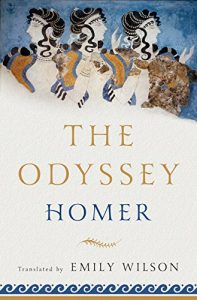
 Summary: The classic story translated by Emily Wilson, narrated by Claire Danes.
I have been preparing to go see Nolan’s version of the Odyssey for the past several weeks. First I read Stephen Fry’s retelling and then I mostly listened but also read a bit of Emily Wilson’s translation narrated by Claire Danes. I have listened to her narrate The Handmaid’s Tale and she has a fairly flat reading style that works for some kinds of fiction but not others. I think it works here.
Wilson translated The Odyssey into verse. Not all version do, some are prose. Generally I think that narrative verse should be listened to. I think that is the case in my favorite verse book, Brown Girl Dreaming. and it is the case with Malcom Guite’s Galahad and the Grail, which I am also reading right now. I tend to get both kindle and audiobook editions because I want to get a sense of the written version of the verse. So I do read about 10 percent of the book. But I mostly listen because these are intended to be heard.
I am not going to get into arguments about the quality of Wilson’s verse or whether Nolan’s version was a good adaptation. I am just not qualified for either of those arguments. Wilson fit the story into verse, there were artistic choices there and some content was shaved to make it fit into verse. Nolan was also adapting a story that has many versions to the screen and also made artistic and stylistic choices. Personally I think it is an artistic masterpiece that also had real misses in some of the choices. Visually I think it was very interesting. I liked the twin themes of grief about war and the concern about how his actions in war led to the larger rejection of “Zeus’ Law” and while I understand how that adapts the original story, I think it makes sense of a modern adaptation. At the same time, I thought Matt Damon’s performance was a bit too flat. And that I wanted the ethics to be a bit more foreign to our modern sensibilities. Not in a way that horrifies us, but rather in a way that shows the ancients as alien to our thinking.
Many people are broadly familiar with this story. But I think the most familiar parts, the Cyclops, the sirens, the whirlpool are not remembered as being such small parts of the book. All three are part of what Odysseus is telling people after the fact when he is acting as his own bard. As one person I saw said, he should be considered one of the first unreliable narrators. I saw someone complaining about how long it too for it to be the real story home (they were insinuating that the book was about Odysseus and therefore of course it would start with his story.) But it is well into the book before Odysseus is really a character in the narrative. We need to understand the scene first. The trojan war, and Armageddon’s death and the displeasure of the gods matter to why it is that Odysseus is losing men and spending time not making much progress.
I do want to read some other versions of the story by other authors (not just other translators). Virgil, Ovid and others also have their own versions and I think some of the complaints about Nolan’s adaptation is that he does draw on other sources, not just Wilson’s version of Homer.
I am not capable of judging the quality of translation, but I think this is a very readable version and I think Danes did a good job narrating. It is worth picking up.
The Odyssey by Homer translated by Emily Wilson Purchase Links: Kindle Edition, Audible.com Audiobook