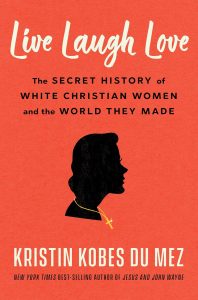
 Summary: A look at women in Evangelical Christianity and how they have influenced and been influenced by the culture.
I read Jesus and John Wayne not long after it first came out. And then I read it again with a book club in 2023. The history in Jesus and John Wayne and now in Live Laugh Love is largely familiar to me. I have read the books and known about the people and followed the news and even met a couple of the people who are mentioned.
I think one of the problems that Mark Noll identified in The Scandal of the Evangelical Mind, and that which I have heard Pete Enns and many other Christian academics expand on, is the problem of the role of intellectualism within Evangelicalism. To tell the story of evangelicalism from a slightly different tack from Du Mez, Neo-evangelicalism’s founders were trying to break away from the fundamentalism’s antagonism toward not only culture, but the tools of the culture. And fundamentalism fought back against evangelicalism with the charge that it was trying to make culture like it and build clout. But over time, those who were fundamentalist in orientation against the broader culture, adopted the evangelical label and many of those who would have been apart of the original neo-evangelical orientation either were pushed out, or left in disgust.
I have seen a number of people dismiss Du Mez broadly over the past week or so with some version of “she is just a marxist.” Early in the book she says, “Ultimately, this book is about power–about women’s power to define their own lives, men’s power over women, and the power women wield over one another. It is about discipleship and devotion, authority and submission, manipulation, cruelty, and control.” (I read a prerelease version provided by Netgalley for purposes of review so I will not give a page number to the quote because my version is likely not paginated as the released version.)
That quote rightly says that she is studying how power impact Christianity. That is not to say that the only thing in the book is power, but to pretend that post-marxian scholars cannot look at power without being “marxist” is like saying that post-Adam Smith economists cannot look at the role of wealth without being capitalists or that biologists can’t look at biological change without being darwinists. Once the a tool has been released into the world, that tool exists and to not use it because of a fear of a label is exactly the type of anti-intellectualism that Noll was rightly concerned about in evangelicalism.
Kristin Kobes Du Mez knows how to write a narrative. She weaves together historical threads that tell a compelling story. If every historian was as good of a writer as Du Mez, I think a lot more people would read more history. But what I think is important to say here for the non-historian (I am not a historian by training, but I have read a fair about about historiography) is that being a historian is not simply telling a story that has connection to historical facts. A historian is researching connections and through-lines and how things are connected. The historian is not just forming a narrative, but trying to explore the connections that already exists and reveal them to the reader. Where historians will disagree is the weight given to various connections or if there are other connection that have more explanatory power, etc.
One of the clearest examples of the connections that already exist, but need pointing out, is that Hannah Whitall Smith’s The Christian Secret of a Happy Life (1875) was cited by Marabel Morgan who wrote The Total Woman in 1973, which was very clearly a repackaging of the Fascinating Womanhood self improvement class, which she had taken and was a facilitator for. Fascinating Womanhood, book and the classes, were written by Helen Andelin, a Mormon, which were inspired by Fascinating Womanhood booklets which were by Elizabeth Towne (also Mormon) in 1922. So one of the best selling Evangelical women’s books in history explicitly cited Hannah Whitall Smith, but then also largely plagiarized Towne and Andelin for the main content of the book without citation.
When Smith’s teachings were mixed with EW Kenyon teachings, which appropriated “New Thought” teachings and the holiness revival movement which had some influence on those who came out of the Pentecostal Azuza Street revival, the result was a type of prosperity gospel. One of the weaknesses of the book, or at least one of the areas where I wanted more, was that Hannah Whitall Smith was oriented toward how the use of the will allowed one to overcome sin. But over time there was a cultural shift which shifted the orientation from seeking after God’s will to change our will to a more amorphous idea of feelings which we then shared with God for what we want. That is a subtle shift, but an important one. Expanding on it would have helped draw connections to why what can too casually be labeled as prosperity gospel is so influential, while being something that almost no one will claim for themselves.
I am going to be too brief here, but the “will” is about aligning ourselves to God and in the Ignatian sense the individual or group of Christians may work toward something they feel called to, but the main orientation is toward seeking after God’s will not their own. In English, the term from Ignatius’ Spiritual Exercises is usually translated “indifferent” which isn’t quite right in modern usage. But that problem of translation is part of what I think needs to be explored more here because in all of these books there is no “indifference’ toward our own will or feelings. Instead these books seek to help people understand their desires so that they can bring them about.
One of the main threads of the book is how this “New Thought” movement mixed in with evangelical theology and practice. New Thought was trying to imagine a result and that act of imagination would bring it about. This the what underlies “The Power of Positive Thinking” or “The Secret.” You can see how Ignatius understanding of indifference to our own will in the light of God’s will, and then Hannah Whitall Smith’s Quaker upbringing prioritized her inner voice, which kept morphing in the 150 years since it was written.
I can’t summarize the whole book but I think there are two threads in Live Laugh Love that are worth attention. The first is how common women’s ministry has emphasized an ideal that the main proponents did not live. Many of the women in this book became rich and/or influential selling their ideas and that required work outside of the home. But many of the ideas being sold were about why women should seek after a domestic ideal. The “prosperity gospel” aspects of this, “if you do this, then God will bless you,” were quite often not present in the lives of many advocates. There is a very good long section on Elizabeth Elliot whose Passion and Purity helped to launch the modern purity movement. She spoke about submitting to God and her husband. But her first husband was a martyred missionary. Her second husband died fairly young with health issues. And her third husband was emotionally and physically abusive starting almost immediately after their wedding was over. She advocated leaning into an ideal of womanhood and family, both because she thought it was the right thing to do, but also because she thought that it would bring about good results in this life in a way that she didn’t experience herself.
The second thread is that there really is a desire in not just Evangelicalism, but both US culture and I think all of humanity, to assume that simple formulas will bring about the results that we desire instead of grappling with the reality that formulas don’t work. Reality is much more complicated and while there is value in doing the right thing for its own sake, doing the right thing will not get us what we want every time. Where I think the “prosperity gospel” label is unhelpful is that there really is value in doing the right thing. And sometimes our mixing of “do the right thing” with “so you will get…” is where the problem lies. As Du Mez shows over and over again, formulas almost never work for most people. But those who sell formulas, often make a lot of money. Those who use the formulas rarely find the results that they want.
In an interview with The Holy Post, Du Mez was directly asked if she thought many of the people who were profiting off of the ideas discussed in the book were simply grifters. She said that she knows that there are grifters in this world. And that there are true believers who are simply attempting to follow what they think is God’s direction. But she can’t get to the internal motivation that would distinguish between the two. She can only point to the results.
There will be lots of complaints about Live Laugh Love (like Bonnie Kristian’s review at Christianity Today) which complain about Du Mez being too negative about Evangelical Christianity. But I think we really do need to grapple with why so many people want the simple formulas for how to live life that are discussed in the book. Those who didn’t like Jesus and John Wayne are unlikely to like Live Laugh Love. But I do think that Live Laugh Love is a more nuanced and mature book. And I hope it finds just as large of an audience as her earlier book did.
Live Laugh Love: The Secret History of White Christian Women and the World They Made by Kristin Kobes Du Mez Purchase Links: Hardcover, Kindle Edition, Audible.com Audiobook