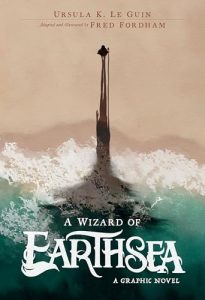
 Summary: Faithful graphic novel adaptation of this classic fantasy novel.
My kids are very big graphic novel fans. I read a handful of graphic novels a year, but I am not a consosouir of graphic novels. (Go check out GoodOkBad as a review site that really does know graphic novels.)
A graphic novel adaptation is hard. Seth at GoodOkBad wrote about the graphic novel adaptation of The Road. It was one that I started but never finished because I thought that it seemed to be missing some of the point of the book.
For The Wizard of Earthsea, I think Fred Fordham did a good job with the adaptation. Even with a relatively short novel like this, a graphic novel just can’t do everything that can be communicated in print. I liked the art and as noted in the introduction by LeGuin’s son, her intention of making the main character dark skinned (in 1968) and the only light skinned characters were villains. But in several of the movie/video adaptations that was stripped from the story.
Wizard of Earthsea is a classic coming of age novel. Ged, the main character grows up without much adult supervision after his mother dies when he is young. His father most ignores him or uses him for labor. But after he overhears his aunt use a magic spell and then does it on his own (to bad effect) she takes him under her wing and starts to teach him what little she knows of magic.
Ged is talented and picks up everything she can teach him quickly. Without much spoilers, he goes from her teaching to being taken on as an apprentice of a wizard then going to a school for wizards. Throughout his life, his pride and desire to prove himself to others is at the root of many bad decisions. And that sets the stage for the main thread of the story.
It is a very simple story with a few rabbit trails that set the stage for later books. At the end of this book Ged is only about 19-20 but he has faced himself and the world and is wiser for his experience.
I read the graphic novel in two evenings. I did like the art, but in print, it was too dark. I think the art was done a disservice in the printing. It may be a rare example of when a digital version would have been better because you can raise the brightness of the screen. Choices have to be made in adaptations and I think the cuts to the story and the emphasis on the feel of the story and the emotion of the characters over narrative explication were good choices. I do think it may be hard to follow if you are completely new to the story. But this is a classic that is pretty widely known with a couple of movie/video adaptations.
I immediately picked up the print version of the book and then about half way through saw it was free on Audible for members. So I mixed the print and audio versions and finished it again in about three days. It is worth noting if you are a follower of narrators that Rob Inglis narrated Wizard of Earthsea. He is the classic narrator of the Hobbit and Lord of the Rings before they were redone by Andy Serkis. The Wizard of Earthsea audiobook was released in 1992, just a year after the Hobbit. I think Inglis’ voice was right for The Hobbit, but too old for the Wizard of Earthsea. I would have preferred a younger voice. The narration was good, but not spectacular. And you can tell it was done over 30 years ago because it was not quite as clear as some newer well recorded narrations.
This was probably my fifth or sixth read of the Wizard of Earthsea. If my notes are accurate, I last read it in about 2012. I think I am going to reread through the whole series again. It is pretty spoilery, (so don’t read further if you don’t want to), but I hadn’t ever thought of the conclusion of the confrontation with the shadow with as much Jungian archetypes as I understood it this time. Ged confronting himself as flawed but also finding love for his flaws (not in the sense of embracing sin but in the sense of embracing created limitations) is essential to the story. And I think that it is a good example of how the very concept of the YA novel has changed. Wizard of Earthsea is a hero story. There is a quest aspect that is part of the classic novel, as well as the rejection of good advice from elders because the protagonist thinks that they know better. And the gaining of wisdom as a result of experience and understanding of how the rules and strictures of community do have purpose even if hardened lines can often go too far.
I got the graphic novel in part to see if I thought my 10 or 11 year old would like it. And honestly I don’t think they would. I think they are still too young for some of the themes of the book and as a graphic novel, I think you need to read the full print first to understand the themes completely. Maybe in a couple of years.
I will include this line that I think does mark the book well:
“You thought, as a boy, that a mage is one who can do anything. So I thought, once. So did we all. And the truth is that as a man’s real power grows and his knowledge widens, ever the way he can follow grows narrower: until at last he chooses nothing, but does only and wholly what he must do . . .”
A Wizard of Earthsea: A Graphic Novel by Ursula K. Le Guin (Fred Fordham – Adaptor) Purchase Links: Hardcover: Paperback, Kindle Edition
1 thought on “A Wizard of Earthsea: A Graphic Novel by Ursula K. Le Guin (Fred Fordham – Adaptor)”