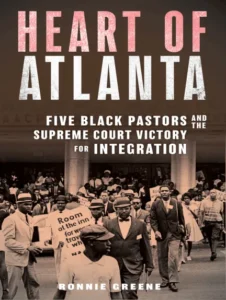
 Summary: A journalistic account of two Atlanta legal cases in response to the 1964 Civil Rights act, joined by the Supreme Court to uphold public accommodations (Title 2 of the 1964 Civil Rights Act).
I do not think I would have picked up Heart of Atlanta if my book club had not decided to go to a book talk with the author at the Atlanta History Center. But Heart of Atlanta is the type of narrow history that I think is exactly what we often miss in our too-quick presentation of the Civil Rights Era. The Civil Rights Era was so transformational because the movement was broad-based. Literally, hundreds of thousands of people participated, at least in minor roles. But even the often significant characters of the era have been forgotten. And the more minor characters were often never really known. One of the best examples of this is that frequently throughout the book, Ronnie Greene will cite a video or picture or newspaper story about these events, and the five main characters of the story were either unnamed or listed as “unknown.” In fact, the men often did not know that there was photographic or video documentation of their protests until Ronnie Greene showed it to them.
All five pastors in the subtitle were students at the Interdenominational Theological Center seminaries (ITC). Two of the five pastors are still living, Albert Sampson (involved in the earlier sit-in movement in North Carolina) and Woodrow Lewis (involved in the earlier Atlanta Student Protest movement). Unfortunately, the other three, Albert Dunn (also involved in the Freedom Rides), Charles Well, and George Willis (both having been in the military before returning to attend college and seminary), have passed away. All five continued their activism after their involvement in these cases, but like many pastors organizing in their communities, they did not obtain national recognition.

 Summary: Young Adult fantasy series that is well-plotted, character-driven, and relatable.