 Takeaway: Part of the importance of Black History Month is focusing on the less well-known figures because so much has been repressed or forgotten.
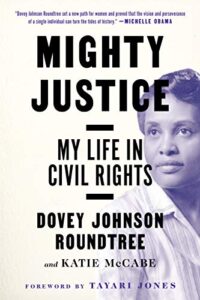
So many historical figures have made so many small contributions to our world that it is hard to believe anyone could have done so much. And at the same time, the fact that they are not more well-known is a testament to how our memories are fickle. I was unaware of Dovey Johnson Roundtree, and I honestly do not remember why or when the book ended up on my to-read list. But I picked it up this month because it is on sale.
Dovey Johnson Roundtree was born in 1914 and lived until 2018 at 104 years old. This autobiography was written with the help of Katie McCabe and published in 2009 under the title Justice Older than the Law. It was then reissued in 2019 with the new title Mighty Justice. Unfortunately, by the time she started working on her autobiography, she had lost her sight due to complications from diabetes. But ten videos of her were recorded by the VisionaryProject , giving a good sense of who she was and what she was like in her early 90s.
When she was four, her father died in the flu epidemic of 1918, and her mother and sisters moved in with her grandparents. Her grandfather was a pastor and well-educated. Her grandmother was a guiding force that is frequently mentioned in her autobiography but was disabled due to injuries from fighting off an attempted rape by a white field overseer when she was a young teen. Dovey Johnson Roundtree came of age during the Great Depression but attended Spellman College by working three jobs. Through the kindness of people around her, she graduated when even those three jobs were insufficient to keep her in school. She taught middle school for two years to earn enough money to support her family but then moved to Washington, DC, and began working as a researcher for Mary McCloud Bethune, whom she met because of her grandmother. Mary McCloud Bethune was one of the most influential women in Washington as the head of the National Council for Negro Women and one of FDR’s informal Black Cabinet. Bethune ensured that during WWII, the Woman’s Army Corp, Black women would be included in officer training. Dovey Johnson was included in the first class and was one of the first women to be made an Army officer. Due to her push against military segregation, she was blackballed but was not court marshaled, unlike several others. She spent all of WWII working to recruit Black women into the military and working on policy groups for desegregation and women’s rights issues in the military.
In 1947, after working in the military, she entered Howard Law School after catching a vision for using the law in civil rights in her brief work with A. Philip Randolph and labor organizing. Because of its location in DC, Howard Law School was the site of many preparations for the civil rights legal cases at the Supreme Court.
Roundtree and Julius Robertson, one of her law school classmates, started a small law firm in 1952 after they graduated. During that first year of their new law firm, they took on Sarah Keys, who sued the Carolina Coach bus company after being thrown off the bus for refusing to move to the back of the bus. Keys was in military uniform, and this was after the 1946 Morgan v. Commonwealth of Virginia, where the Supreme Court ruled that segregated bus travel was unconstitutional. But there was no enforcement of the 1946 ruling. Roundtree and Robertson sued the bus companies for violating the contract and for having Sarah Keys arrested for refusing to move seats. They lost the case in state court and appealed it to the Interstate Commerce Commission administrative judges. For Dovey Johnson Roundtree, this was not just an important case but mirrored her experience of being ejected from a bus in the same type of incident when she was a military recruiter in 1943. After three years of hearings, legal maneuvers, and appeals (in 1955), the full ICC ruled that
“We conclude that the assignment of seats on interstate buses, so designated as to imply the inherent inferiority of a traveler solely because of race or color, must be regarded as subjecting the traveler to unjust discrimination, and undue and unreasonable prejudice and disadvantage…We find that the practice of defendant requiring that Negro interstate passengers occupy space or seats in specified portions of its buses, subjects such passengers to unjust discrimination, and undue and unreasonable prejudice and disadvantage, in violation of Section 216 (d) of the Interstate Commerce Act and is therefore unlawful.”
Read more
 Summary: A new story about Sherlock Holmes’ older brother Mycroft.



 Summary: A theological exploration of the culture led to Stand Your Ground laws.