Between the world of Ta-Nehisi Coates and Christianity

Between the world of Ta-Nehisi Coates and ChristianitySummary: Seven essays on Ta-Nehisi Coates and Christianity. 

I appreciate Ta-Nehisi Coates. And I was intrigued when I saw this book because Coates is a vocal atheist. I think he is respectful of Christianity, but he rejects Christianity largely because of its followers. It is a position that I easily understand, even if I do not reject Christianity for the same reason.

Books that are collections of essays are hard to do well. They are almost always uneven in their writing quality. And rarely hold together and build on one another well. And most of the time the sum is less than the individual parts.

I think there were two or may be three essays here that were pretty good. None of them were awful. But in general, while there was thoughtful aspects of to Between the World of Ta-Nehisi Coates and Christianity, I would recommend just reading Coates directly.

One of the aspects that I know has irritated Coates and because it keeps coming up, has begun to irritate me as well, is the issues of Coates’ “˜hopelessness’. There were two essays directly about this and two more mentioned it. (Spread the essays out, two essays, both about Coates and Hope right at the end was odd.) Coates has said that he doesn’t believe he is hopeless, he believes that he is a realist. Reinhold Niebuhr led a movement of “˜Christian Realism’ that to me feels more like what Coates is trying to communicate.

Read more

Captain Marvel: What Makes a Hero by Pamela Bobowicz

Captain Marvel: What Makes a Hero by Pamela BobowiczSummary: Both an introduction to female heroes and an exploration of selfless values.

My four year old son has started discovering Marvel superheroes. A couple days ago we were using some of his left over birthday money to pick out a few new kid’s oriented Marvel books. I picked out this one at the same time, both because I want my son to know that Superheroes are not all male and for my daughter to have female superheroes as role models. It is important that both my son and my daughter see women as potential superheroes.

I do not often post about the books I read with my kids, but I am both encouraged and a little bit angry about this book. The book itself is great. It has a 2 page introduction to 14 different “˜heroes’. Each introduction has enough to sort of introduce who the character is (some really need more introduction) and something about the value that the character holds. The values focus on selflessness, fighting for the weak and powerless, being innovative (for the greater good), working together, supporting others, etc.

Read more

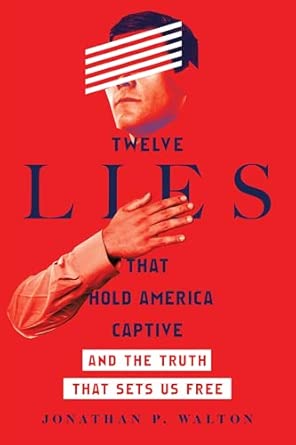
Twelve Lies That Hold America Captive: And the Truth That Sets Us Free by Jonathan Walton

Summary: An exposure of how “˜White American Folk Religion’ and Christianity are not the same things.

It is not surprising at this point, or it should not be, that many Christians seem to be confused about how Christianity and the American Dream overlap and contradict. Often Christians are discipled to believe that the abundant life that Jesus talks about is actually fulfilled in the American Dream.

Jonathan Walton is not confused, and so, somewhat provocatively, but I think accurately has set out to separate the American Dream from Christianity by illustrating what is “˜White American Folk Religion’ and what is Christianity.

As with any project, like this, some people will identify with some of these lies more than others. What I find easy lies to believe will not necessarily be the same as what you do. If I were writing the book I would probably have a slightly different list. But the working out of these does expose how we have been discipled by patriotism more than Christianity quite often. James KA Smith talks a lot about secular liturgies that disciple us, Jonathan Walton is really doing the work of exposing these secular liturgies so that we can work to reframe our beliefs and actions around actual Christianity.

In general, Walton is telling this story autobiographically. Each chapter is a different lie, and so he identifies how he has previously believed or been impacted by the lie then deconstructs the lie and replaces it with right belief and right behavior (similar to how James Bryan Smith approaches understanding and resounding to God in The Good and Beautiful God. In most cases I think this method is a strength of the book. It is disarming when the author focuses on his sin and confesses it as a way to help us see our own sin that may be slightly different, but still related. There a places however, where I think that he was reaching a bit too far to make the connection and could have better used different people as illustrations so that there was a closer connection. But overall, I do think the method was helpful.

Read more

Beauty: A Very Short Introduction by Roger Scruton

Beauty by Roger ScrutonSummary: A brief introduction to what beauty is, why it is important and why we need to understand it.

I listened to this on audiobook, which was fine, but may not have been the best choice. While this is part of the Very Short Introduction series, it is still a book that is ultimately philosophy. About 2/3 of the way through I picked up the kindle edition, both because I know I need to re-read the book, but also because Scruton was referencing a number of paintings and many of those are in the Kindle edition.

The pictures are black and white even in the kindle version, so the reader cannot really get a full sense of what is being shown, which does matter for a discussion of the artistry and beauty of the paintings, but it at least is a reference.

I have been wanting to read more about beauty for a while and consistently when I look around, Scruton’s book Beauty is recommended as one of the best introductions. The Very Short Introduction series is very uneven, but Beauty is an example of what all of the books should be like. He is not avoiding discussion of the academics, but the point of the book is to talk about the actual subject. A number of the other Very Short Introduction books I have read have been about the academic study of the subject, not the actual subject. I do not really want to read about what academics have argued about over African History, I actually wanted to understand something about African History.

Read more

A Legacy of Spies by John le Carré

A Legacy of Spies by John le CarréSummary: A follow up, along with back story for le Carré first big novel, The Spy Who Came in From the Cold.

About the time the movie Tinker, Tailor, Soldier, Spy came out, I started reading John le Carré. Over a couple years I read most of the George Smiley novels. There are a few I have to finish, but honestly I thought I had finished them all until was looking when I picked up A Legacy of Spies.

The Spy Who Came In From the Cold I think was my favorite. I have re-read it again since the initial reading. I really like le Carré’s writing, but there is a hopelessness to the book that is brought about by the moral ambiguity and the methods that the spies in the books use. George Smiley attempts to be right. And he knows what is right. But he doesn’t always do what is right to accomplish the right ends. Despite this, Smiley has an awareness of what right and wrong are. But that is not true of his bosses or the lawyers or politicians or frankly anyone else that is around him.

The Legacy of Spies is a follow up to The Spy Who Came in From the Cold. It is set long after the initial book ends. Part of the point is that those that are now looking into the work of that earlier era do not have any of the real memories of what the era was like.

Legacy of Spies centers around Peter Guillam, a protegé of Smiley’s and one of the very few that actually knew what was going on with the story that was told in The Spy Who Comes in From the Cold. There is a good bit of back story here that fills in some holes, but also reminds those that read the Smiley books long ago, what the story was all about.

Read more

Can “White” People Be Saved?: Triangulating Race, Theology, and Mission

Can Summary: Provocative and helpful look at how race impacts Theology and Missions.

I have been VERY slowly reading Can White People Be Saved. Over the past three and a half months that it took me to work through a little over 200 pages actual text I spent a lot of time thinking and re-reading.

I did not do this with every single talk, but with most chapters, I would read the chapter, then watch the talk and then sometimes read the chapter again. I think I watched most of the talks and responses and Q&A periods that are online. And I read all of the text.

Any conference book will have some chapters that are more interesting to a particular reader than others. But I was pretty engaged in most of the talks. The first two I think were the two that I spent the most time on. The title talk Can “œWhite” People be Saved by Willie James Jenkins comes round about the subject to say yes “˜White’ people can be saved, but similarly to the rich young ruler whom Jesus said needed to sell all that he had. Jenkins, as is common among many that are talking academically or from an activist position is not talking about all people that have light skin color that most call White, but of those that have claimed White identity as their marker, an identity that views racial superiority as implicitly true. There is nuance and care here, but I think the basic talk, as provocative as it is, is also essential. Many people that call themselves White do not understand the cultural assumptions that they are bringing to their Christianity, and how those assumptions impact how they think about Christianity. As Jesus said to the rich young ruler, you may have followed the law, but there is something that is hindering you from God.

The second chapter, by Andrea Smith, is talking about Decolonizing Salvation and processing Christianity through Indigenous eyes. This is probably the chapter that I felt most blindsided by. I have read a little bit about Indigenous theology, but only a little bit, and the issues brought up, like how Indigenous people tend to not identify with the Exodus story as many Liberation theologies do because of the history Indigenous people in the US. This is a chapter that completely makes sense to me once I read it, but it also concerns theological areas I had never considered because I did not have enough cultural awareness of Indigenous issues.

Read more

White Rage: The Unspoken Truth of Our Racial Divide by Carol Anderson

White Rage: The Unspoken Truth of Our Racial Divide by Carol AndrsonSummary: The recounting of five White backlashes to Black gains in the country. 

White Rage is not particularly long. It does not talk about everything, but instead gives an overview of five historical movements. We all know the history of the the events before these movements of White Rage, but the importance of Carol Anderson’s book is the framing of the story as Black gains then White rage.

The five movements pairs are, 1) end of slavery and reconstruction with the backlash to reconstruction and “˜redemption’. 2) The great migration pairs with the (White) race riots of the late 1910s and early 1920s. 3) Brown v Board with the anti-integration movement. 4) Affirmative action and the anti-affirmative action policies. 5) Obama’s election and the movement toward voting restrictions. These are not definitive for all of the examples of White Rage in US history but emblematic. And like what Jemar Tisby pointed out in Color of Compromise, each one was less overt and more subtle than the last, but still rooted in racism.

One of the aspect that keeps coming up in histories of reconstruction and the Jim Crow era is the relationship of arguments around states rights and racism. I know many people that are ideologically oriented toward Libertarianism at some level. I am unaware of any of these people adopting these political ideologies because of racism. But I also do not think that many Libertarians or small government advocates understand the racial history of Libertarianism or small government policies. Obviously, there has been plenty of racist results from national government policy as well. But part of grappling with history, has to be grappling with how different policy orientations have been misused to oppress. And while that does not mean that Libertarianism or small government, pro-business political orientations cannot be advocated, it does mean that there needs to be particular attention paid to how those political orientations and specific polities can uphold racism.

As is detailed throughout the book, even when the federal government was interested in protecting Black civil rights (which it often was not) courts or local government officials often actively worked against the federal government. In the Reconstruction era, the courts routinely ruled that the 13-15th Amendments could not be applied to the state or local government, or if they were, the federal government did not have the authority to intervene. In other words, if a local or state government violated a Black person’s right to vote, the federal government, even in a federal election, could not act to protect that right to vote. The person who’s rights were violated could only appeal to the  very same government that had violate his rights (this was before women’s right to vote, so it was always his rights being violated.) It wasn’t until the Voting Rights Act, which has been significantly restricted in recent court rulings, that federal law was applied to enforce not just the right to vote, but the action of voting.

Already by the mid 1870s, charges of what is now commonly referred to as “˜reverse racism’ started to sweep through the courts. From the 1877 Hall v DeCuir which ruled that states could not prohibit racial segregation, then a series of cases in 1880 that allowed for constitutional exclusion of Blacks from juries to the final nail of Plessy v Ferguson in 1896, which effectively eliminated 14th Amendment protections, the roll back of Black rights happened because of either courts, or the unwillingness of federal government to actually enforce rights in the face of White backlash.

Read more

The Forgotten Creed: Christianity’s Original Struggle against Bigotry, Slavery, and Sexism by Stephen J Patterson

The Forgotten Creed: Christianity's Original Struggle against Bigotry, Slavery, and Sexism by Stephen J PattersonSummary: A case for “There is no Jew or Greek, slave or free, male and female; since you are all one in Christ Jesus” being part of an ancient baptismal creed.

I picked up The Forgotten Creed because of conversations around race. As I have listened and participated, the passage in Galatians 3:28, “There is no Jew or Greek, slave or free, male and female; since you are all one in Christ Jesus” (CSB) is frequently brought up. Usually when it is brought up in these conversations, it is being cited by White Christians that are using it to say that Black and other People of Color are in sin because they are paying too much attention to their racial status.

That reading is not what I understand Gal 3:28 to mean in context. But when I saw The Forgotten Creed I thought I should read more about the history. Patterson from the very beginning is taking a clear position. He mentions identity from the very beginning and I think that opening with a clear position of focusing on identity will alienate some readers.

But right before the mentioning of identity in the In the introduction Patterson suggests that the common scholarship for Colossians, Ephesians, 1 Timothy, and Titus is that they are a pseudonymous, which he says are “˜forgeries’. That is not a great opening. Essentially it is the only thing that World Magazine says about the book in its short review dismissing the book. Patterson has been part of the Jesus seminar and his demythologizing includes dismissing Paul’s conversion story and removing Paul and Barnabas’ commissioning by the Antioch church and replacing it with Paul leaving in disgrace because the circumcision party at Antioch pushed him out. All of this really undercuts Patterson’s argument with many of the people that he wants to convince of his main point.

The main point of The Forgotten Creed is that Paul is citing an early baptismal creed (one that Paul likely didn’t write but was citing) that called on Christians to transcend, class, ethnicity and gender, three lines that were not crossed in the culture around the early church. This is similar to the way that NT Wright, in his biography of Paul similarly suggests that the early church was unique in the way that it transcended geography (national boundaries), ethnicity or culture, and class. So Patterson is not claiming something unique or original here. But he is suggesting that it was a focus of the early church that seems to have gotten lost fairly early in the church history. First in becoming detached from the Jewish origins. And then becoming patriarchal.

Read more

How to Fix a Broken Record: Thoughts on Vinyl Records, Awkward Relationships, and Learning to Be Myself by Amena Brown

SHow to Fix a Broken Record: Thoughts on Vinyl Records, Awkward Relationships, and Learning to Be Myself by Amena Brownummary: Part memoir, part life skills, part spiritual direction, lots of humor and heart. 

I have seen Amena Brown perform her spoken word poetry live twice I think. She mixes deep thoughts with humor and great writing. I picked up How to Fix a Broken Record on audiobook when it was on sale a few weeks ago. I moved it to the top of my list after listening to Amena Brown interview Hillary Yancey about Yancey’s book Forgiving God.

How to Fix a Broken Record is the type of young-ish Christian memoir that I really like to read every once in a while. The 30-something’s thoughts on life and love and what is really important. I get down on Christian Publishing at times, but Christian Publishing does print a number of books that are really good but do not get wide readership.

How to Fix a Broken Record is a roughly chronological spiritual memoir, early life, dating, church thoughts, career, eventual marriage, more thoughts on art and calling, miscarriage, the learning to be an adult, health issues, maturing. I am guessing, but I think I am probably about 7 to 10 years older. Some of her experiences are ones that I have lived through myself, many others are not. But they are still identifiable as common to the human condition. But like many other memoirs it is the telling and thoughts on them that matters, not the uniqueness of the experiences.

Read more

Hannah Arendt: A Life in Dark Times by Anne C Heller

Hannah Arendt: A Life in Dark Times by Anne C HellerSummary: Brief (140 page) biography of the philosopher and public intellectual Hannah Arendt. 

Like way too many books, I picked this up when I stumbled across it while looking for something else. It was a Kindle Deal of the Day last week, and it is also included, with audiobook in Kindle Unlimited. I am currently in a trial for Kindle Unlimited and I have been using too many Audible credits and my library has a long backlog on the audiobooks.

But it is this point where I admit that I picked this up having confused Hannah Arendt and Simone Weil. Both were of the same approximate generation. Both were Jewish and impacted by World War II. Both became Christians, while retaining a hold of their Jewishness. Both were philosophers that have had significant impact through their writing. Weil died young, only 34, during World War II. Arendt died in 1975 after having lived in the US for 35 years. (I think I also mixed up Johnathan Arndt, the 15th century German Pietist in there too.) Weil was one of the thinkers that Alan Jacobs focused on in his The Year of Our Lord 1943.

Arendt is best known for her phrase “˜the banality of evil’. And it is there the book opens with the controversy of the Eichmann trial toward the end of her life where she used the phrase.

This is a very brief book. The basics of her life is covered. She grew up in a secular Jewish family, with a very sick father. She was brilliant and received a PhD in philosophy at 23. It was during her work on her PhD that she met and had an affair with Martin Heidegger. It is hard not to think about the ways that common sexism impacted her life. Heidegger kept her as a lover but kept her detached. Both of her husbands seem to have taken advantage of her in some ways. She worked and supported herself, but at least at times both of her husbands when they were not working. Affairs seem to have been common among the men in her life.

Read more