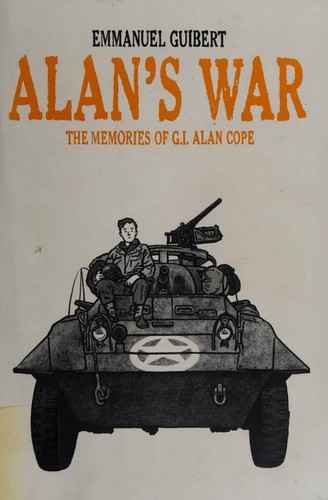
 Summary: A WWII soldier tells his story.
As I have said with most of the graphic novels I have read this year, Alan’s War was a recommendation from Seth Hahne (check out his blog Good Ok Bad). I picked it up based on my enjoyment of graphic novel as history book in the March trilogy.
Alan’s War is the story of Alan Cope. The artist Emmanuel Guibert met him by accident on a beach in France and they struck up a five year friendship until Cope’s death in 1999. Alan Cope fought in Europe in WWII, and after a brief return to the US, he spent the rest of his life in Europe. Originally written in French and translated into English, Alan’s War was released in the US in 2008.
Alan Cope was young. He didn’t turn 18 until the middle of the war. Right at the end of the war, just as he turned 20, he was transferred to Europe. Cope did not see any real battles, but the horrors of the war were still all around him.
Roughly the first half of the book is about World War II. But the rest of the book about his life after the war. He did see battle, so I do not think a PTSD like armchair diagnosis is appropriate. But war does not just effect soldiers through PTSD.
Part of the benefit, and I think part of the problem for Cope is the exposure to the world in a way that broke many of his preconceptions. He seems to have been a gregarious and outgoing person. Most of the stories are about people. Those people introduced him to new ways of thinking, new ideas and new things things. In the army, in Europe, and in US after the war, he met both good and not so good people. Many of those good people rejected Christianity and eventually so did Cope (who was studying to become a pastor after the war.)