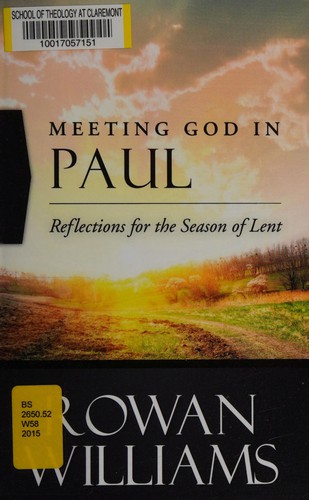
Meeting God in Paul: Reflections for the Season of Lent by Rowan Williams

Meeting God in Paul: Reflections for the Season of Lent by Rowan WilliamsSummary: An overview of Paul to help us see Christ.

I have appreciated reading a couple of Rowan Williams’ books over the last year. Williams writes on a wide variety of topics. I glanced through his list of books as I was prepping this review and he has books on Christian history, theology, literature, other Christian groups (outside of his own Anglican background), poetry, spiritual practices, biographies and more.

The two previous books, and this one, were Lenten lectures that were turned into short books. I will have to pick up a longer book eventually, but these short books allow my restricted schedule to get intellectually satisfying content in a short form.

Williams has three basic chapters on Paul. The first introduces him and his setting. The second focuses on the idea of the church welcoming all. The third is about Paul’s vision of the New Creation.

Read more

Whose Body? by Dorothy Sayers (Lord Peter Wimsey Mysteries #1)

Reposting my 2013 review because the Kindle Edition is free today only. The audiobook is $2.99 with the purchase of the free kindle book.
Whose Body? by Dorothy SayersSummary: An amateur detective (and younger brother to a Duke) helps a Scotland Yard officer solve a murder.

In my ongoing quest to read more old literature, I picked up the first book in Dorothy Sayer’s Lord Peter Wimsey series.  Generally the reviews were mediocre.  Most people agreed that this isn’t her best book and not the best of the series.  The Audiobook review (which is how I read this) were even less kind.  There are two copies of this at Audible, both are narrated by middle aged British women.  (I listened to the sample for the one I didn’t get and both sound very similar.)

Maybe it was the very low expectations that I had coming in, but this was an enjoyable mystery.  I am not a huge mystery fan, I don’t really like the traditional Sherlock Holmes style detective who is just so much smarter than everyone and figures things out.  But Sayers is intentionally writing Lord Wimsey to be an anti-Holmes.  There are several passages about how Holmes is not real and how real police work different than Holmes or most other books.

Although it is a bit of a stretch, this feels more like the TV show Castle than anything else (without the sexual chemistry between the police detective and the amateur sleuth).  Peter Wimsey is a relatively young, single, carefree man that is part of the Nobility, but does not have a particular role to fill.  He is a younger brother, so he is not the Duke, he has not gone into politics or law.  He is well educated, but not a professional.  So he has made a hobby of being a detective.

Read more

Wired for Intimacy: How Pornography Hijacks the Male Brain

Wired for Intimacy: How Pornography Hijacks the Male Brain

Takeaway: Social and personal effects of pornography really are more devastating than I thought.

The promise of Wired for Intimacy is that it can speak to the problems of pornography both from a Christian/theological/moral perspective and a neurological/psychological perspective. Some people are drawn more to one type of argument or the other. But I think it is important that there is an attempt at both sides. Without the theological, there is just a pragmatic science. Without the science, it is one person’s theological system against another.

The first half of the book progresses from definition of pornography, to the social issues that occur because of pornography, to the neurological effects on the male brain from exposure to pornography. This is the heart of the book. The main issue, identified neurologically, is the potential for creating sexual triggers that are based more on pornography than a sexual partner. And the earlier a person is introduced to pornography the more likely that sexual response will become dependent on pornography and create sexual dysfunction when sexual response is desired with a human partner.

Sexual response for a male is more complicated than I would have imagined. There are a variety of chemical, hormonal, and other neurological responses that usually occur in the progression of arousal through to orgasm. But when pornography is used, several of the steps are skipped. When the brain becomes used to skipping steps, the ability for a man to have a fuller sexual response becomes limited. (There is a lot of neurological science in the book that I am skipping.)

For readers that are Christians I think that chapter 2 (Corruption of Intimacy) is important. But for readers that are non-Christian (as most of the negative reviews on Amazon indicate) there is a need for a discussion that is based in science but uses more abstracted moral argument that is not based solely in Christianity. Even counselors that are Christians and pastors could use assistance in helping people that may be starting at a different theological point. That being said, as a Christian, the fact that pornography inhibits the ability to hear the Holy Spirit I think is important (but that really only works if pornography is an addiction and the case has to be made scientifically that there is an addiction.)

Read more

The Jesus Prayer: A Cry for Mercy, A Path of Renewal by John Michael Talbot

Summary: “Lord Jesus Christ, Son of God, have mercy on me, a sinner.” It is easy to read about prayer instead of praying. But good books on prayer, when partnered with actually praying can be helpful.  I have read about the Jesus Prayer with Frederica Mathews-Green several years ago. And the Jesus Prayer has been a regular part … Read more

Surrender to Love: Discovering the Heart of Christian Spirituality by David G Benner

Takeaway: God is love is not the only important thing in theology, but it may be one of the harder parts of the Christian life to truly accept.

I have a theological bias. I believe that any description of God and the Christian life that does not include God’s love as central to his essence, not just one of his characteristics, is missing the heart of the Christian life.

Yes, the “God is Love” can be and has been misused. But I would much rather move toward the potential over-adoption of God is love than the under-adoption. Going too far is balanced by prevalent themes in scripture. But under adoption of the ‘God is love’ principle fundamentally changes the nature of Christianity. It becomes performance based, rule following, and eventually a self-saving religion that rejects the concept of grace and ceases to be the orthodox Christianity of scripture.

I like to be (and need to be) continually reminded of God’s love of us as fallen, broken humans. David Benner (who I have read previously talking about spiritual direction) has expanded and re-issued a trilogy of books which starts with Surrender to Love.

Read more

The Bible Tells Me So: Why Defending Scripture Has Made Us Unable to Read It by Peter Enns

I am reposting this 2015 review because the Kindle Edition is on sale for $1.99 again.

Takeaway: A high view of scripture is not based only on literal reading. It can also be based on how seriously we take the insights into God.

This review is not going to be adequate to the book for a couple reasons. First, I am writing it right before it is being posted, so it is not as well thought out as it should be. Second, my wife is due with our second child today, and I just haven’t had time to devote much to Bookwi.se lately. But because The Bible Tells Me So went on sale on kindle last night ($1.99), I thought I should get a few quick thoughts down now (it ended up not being quick).

First, I want to say that The Bible Tells Me So is a popular level book. It is fairly short and quite often funny. This is not the academic slog that was Enns’ Inspiration and Incarnation. (I thought it odd that several of the complaints on Amazon reviews were mostly about being put off by Enns using humor.)

The main point of the book is that the modern understanding of Scripture as rule book or guide-book or science book actually changes scripture to something that is different from what early Christians understood and how the writers seem to have intended.

Read more

Carrots: A Shelby Nichols Adventure by Colleen Helme

Carrots: A Shelby Nichols Adventure by Colleen HelmeSummary: A stay at home mom get shot in a robbery and starts being able to read minds. 

I have mostly stopped picking up free kindle books. Mostly because I have hundreds of unread kindle books that I previously picked up and never got around to reading.  But occasionally I will see one that looks good. Carrots was free on kindle two weeks ago and I picked up the audiobook for $1.99. I needed something light and fun for background as I was doing work.

Carrots is a cozy mystery. Shelby Nichols, a stay at home mom, gets shots in the head as part of a robbery. When she wakes up at the hospital she eventually realizes that she can read minds. This is a gift that she really doesn’t want. She doesn’t want to know what her husband is thinking or what her kids think of her. She especially doesn’t want to know what her mom is thinking. Through a series of mishaps, she ends up being forced to work for a mob boss reading other people’s thoughts while trying to catch a killer and keep her family safe and her husband away from his co-worker that is trying to seduce him.

Read more

Know the Creeds and Councils by Justin Holcolm

Takeaway: While we are not saved by our beliefs, knowing why we believe what we believe is essential to right belief.

One of the things that I have become more sure of as I have aged (and read more books) is that salvation is not simply about right belief. I Cor 13 seems to directly address the common, but unfortunate, problem that many modern Evangelicals (and other Christians have). I Cor 13 suggests that we may be right in the external features of our faith (knowledge, miracles, suffering for God) but still be missing the essential feature of Love.

So I think many, especially of the non-denominational and free church varieties of Christians, have rejected some types of knowledge in a partial attempt at being more about personal experience of faith than about the knowledge of faith. I think often this is a false dichotomy.  We need the personal experience of Christ’s love for us (and our corresponding response of love for others) but we do not need to reject our knowledge (or history) to get it.

This past weekend I was talking to my Dad about theology (a common topic for us since he is a pastor and I like to read theology for fun.) One of the things that came up is that Evangelical theology is often narrow. The problem is not with the particulars of that theology, but with the narrowness. As a response some people want to reject one narrow theology and just adopt a new narrow theology.

But the better choice is to read and talk widely within the different streams of the Christian church precisely because we need those various streams to understand the fullness of the Christian faith.

As an example we need not reject the the penal substitution model of the atonement to understand that it is just one of the models of the atonement that is part of historic Christianity and biblically supported. Yes there are weaknesses to that particular model, but there are weaknesses to all of the atonement models. All are simply models that help us to more fully understand why Christ chose to come to earth, fully incarnated as a human, die and be raised again in a new (still incarnated) body. The model is not the atonement itself, but simply a model to help us understand the atonement.

None of that is a review of Justin Holcolm’s book Know the Creeds and Councils. But it is relevant because part of learning about the different streams of faith is important to understanding how they relate and where we agree. Virtually all streams of Christianity can affirm the earliest creeds, the Apostle’s Creed and the Nicene Creed. But understanding how those creeds and later creeds as well as later councils that helped form much of what we now believe, matter because it is the history, not only of our own stream, but of the other streams of Christian faith as well.

Read more