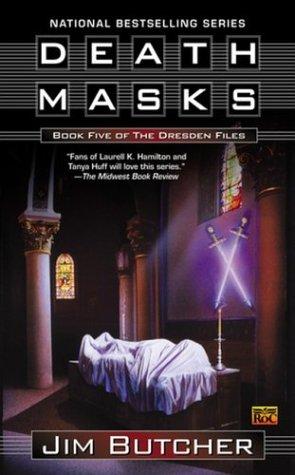
 Summary: Dresden, not quite as much of a mess this time, is searching for the Shroud of Turin, everyone else is trying to kill him.
Dresden is Chicago’s only professional Wizard. Essentially he is a Private Investigator for supernatural issues. That is when he is actually working and not trying to save the world from certain destruction.
Death Masks comes fairly closely on the heals of Summer Knight. The Red Court (the vampires) have declared war on the White Court (the Wizards) and in particular on Dresden. So the vampires are still trying to kill him. The local crime lord,who Dresden has previously had an uneasy truce with, seems to have some of his goons after him as well. And Susan, his (maybe ex) fiancée who is part way through her transformation to a vampire herself after trying to save Dresden in book 3, is back in town.
All of that is in addition to an actual job, finding the Shroud of Turin, which was recently stolen.
Michael, a Knight of the Cross, who was last in Grave Peril (#3) and is one of my favorite characters, is back. Michael is Catholic and devout and carries a sword around while defeating evil, raising his brood of kids, working as a contractor and keeping his wife happy. This time he is joined by two other Knights that are trying to save Dresden.
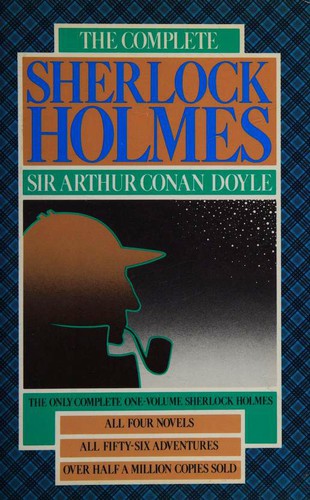 The Complete Sherlock Holmes: The Heirloom Collection is indeed the complete collection of Sherlock Holmes stories by Arthur Conan Doyle. All four of his novels are included as are all of his short stories. From reading the novels and many of the short stories, one can discover exactly how Sherlock and Watson have become the beloved detective and sidekick that we know them as today. You can also see how some images or characteristics of the detective may be more accurate than others.
 Summary: A farcical skewering of politicians, money and regular people trying to make a living.
 Summary: Basis of the movie and beloved TV show, and well mined by them both for ideas.
 Summary: A farce in the style of PG Wodehouse (or vice versa) poking fun at the triviality of Victorian society.
 Summary: Georgie is tasked by the Queen to help with the transition of lost distant relative to his new role as heir to a Duke. (Of course someone ends up dead.)
 Summary: Death, Life, Meaning and other light topics.