 Summary: An evangelical historian approaches why so many Evangelicals voted for Trump.
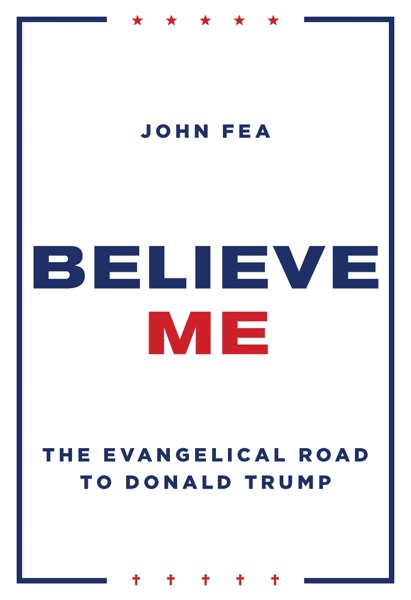
I am a fan of the John Fea’s history podcast, The Way of Improvement Leads Home. I do not remember how I ran across it, but I have listened to it almost from the very beginning. Some of the ideas of Believe Me (title is from Trump’s often used phrase) trickled out over the past months. And the most recent podcast episode was directly about the book Believe Me. On Saturday, when I had a six hour drive by myself, I listened to the audiobook of Believe Me basically in one sitting.
After demonstrating that he is in fact an Evangelical, Fea starts with the common ‘81% of White Evangelicals voted for Trump’ and his wondering if 81% of his Evangelical megachurch voted for Trump the next Sunday after the election. This is not unlike many Evangelicals that I know that have been against Trump all along. They felt the election personally.
The main explanation of the Believe Me is that Evangelicals voted for Trump out of fear, a desire for a Christian nation and the power to construct it that way, and nostalgia. I think that Fea is best when he is attempting to be generous in understanding the reluctant Trump voter and his historical explanations. Fea’s other books include books about whether the United States was founded as a Christian nation, why we should study history and a history of the American Bible Society, all of which make their ways into the book at one point or another.
Fea places all three factors, fear, nostalgia, and power (Christian nationalism) in historical context, asserting that it is not just in this one instance that these three factors have come into play, but that there is a history of Evangelicals choosing these over their Christian ideals. There are places where I think that Believe Me may have been rush to print just a bit too quickly. He explains the DACA program incorrectly. He could be clearer about what the 81% number really was. The definition of what an Evangelical is I think should have been developed more clearly from a historical perspective. In many ways Evangelical, which means something pretty specific in the second half of the 20th century, is mixed up with conservative Protestantism or Fundamentalism or any Protestantism of earlier generations. I think that weakens his historical argument in a few places because some of the historical parallels he is drawing may not be quit as clear for some that want to haggle about what Evangelicalism has meant historically or today.
 Summary: A book on physical and spiritual healing, published in 1947 by a Episcopal Priest’s wife. Anges Sanford mentored and impacted many, included Dallas Willard.
 Summary: A broad overview of Rachel Held Evan’s hermeneutics of reading the bible, written for people who don’t really use the word hermeneutics.
 Summary: A 14 year old boy tries to escape his destiny.
 Summary: Based on a series of lecture about how our understanding of our personal testimonies impacts the way we understand Christian Faith.